By Damiete Braide
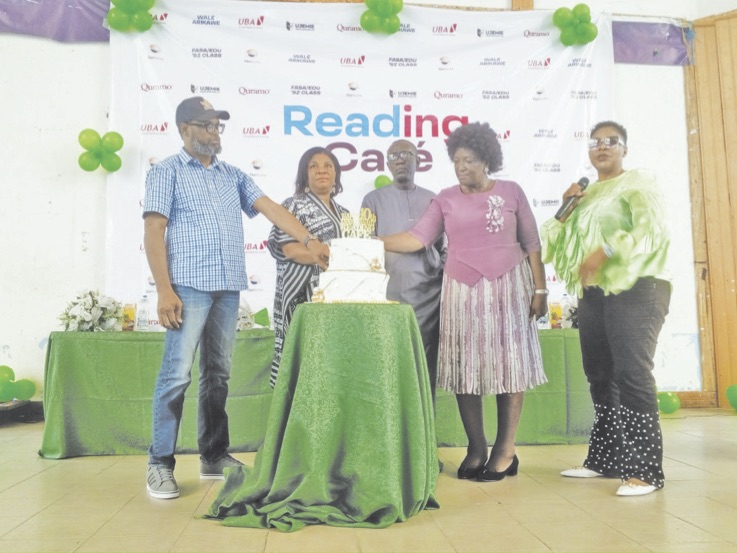
Afe Babalola Hall, University of Lagos witnessed a celebration of vision, perseverance, and the written word as the ReadingCafe marked its 10th anniversary last week.
The event, held under the theme of literary reflection and encouragement, was convened by Lechi Eke, who founded the initiative a decade ago following a divine instruction that would eventually transform the literary culture of UNILAG.
In her address, Eke reflected on the origins of ReadingCafe, recounting how, during a spiritual retreat in June 2012, she was prompted by God to start what was then simply referred to as “a Reading” at UNILAG. The instruction was unclear at the time, a gathering where people would read books aloud and discuss them. She initially hesitated, uncertain of its significance or future. However, a search on the internet eventually led her to accounts of public readings by Charles Dickens in America, which gave her the first glimpse of what the concept could become.
Despite the divine nudge, the early days of establishing ReadingCafe were marked by rejections and fruitless meetings. When she reached out to the then Vice Chancellor in writing, she was pleasantly surprised to receive a response within three days, a moment that gave her hope. She was referred to Prof. Duro Oni, who later directed her to the English Department, her alma mater. But several attempts to find institutional support yielded little success.
Frustrated but undeterred, Eke took a different route in 2015, this time engaging directly with the students’ association, NASELS (National Association of Students of English and Literary Studies). That partnership, along with backing from FinishedWork and the English Department, led to the first edition of ReadingCafe, an event so significant it marked the beginning of a transformative decade.
That inaugural edition remains etched in her memory. It featured renowned figures such as Prof. Akachi Adimora Ezeigbo, Dr. Patrick Oloko, novelist Toni Kan, and poet-broadcaster, Wana Wana. Her children’s principal at the time, Mr. Nkono Ogene Nkono, served as the master of ceremonies and even gave a theatrical performance of Abiku. Eke also read from her unpublished novel, The Girls Are Not to Blame, describing the event as “magic.”
Since then, ReadingCafe has grown in strength and reputation. It has hosted celebrated writers and critics, empowered students through literary mentorship, and even provided financial rewards through competitions. “I’m always delighted when someone walks up to me at a major literary event and says, ‘I used to attend ReadingCafe at UNILAG,’” she shared proudly.
Looking ahead, Eke envisioned the birth of a Creative Writing School stemming from the platform. She invited anyone interested in serious writing to register separately for upcoming workshops and training sessions. She expressed deep gratitude to NASELS’ presidents and executives over the years, as well as supportive lecturers, friends, and sponsors.
Among those acknowledged were Prof. Akachi Adimora Ezeigbo, her long-time mentor; Dr. Nurayn Fola Alimi, who has remained a key supporter since 2015; Prof. Hope Eghagha, whom she praised for his encouragement and vision for “literary action” at UNILAG; and the late Mrs. Roseline Igbokwe of MRS Oil, who helped secure funding for the inaugural event.
She also thanked Mr. Wale Arikawe, Mrs. Nike Omonubi of West African Book Publishers, her younger brother Endy George Ikoro of PrintPlanet, and her family and church community at The Redeemed Evangelical Mission (TREM), including Bishops Mike and Peace Okonkwo and Rev. Kayode Odiaka.
Eke’s speech included a passionate appeal for greater sponsorship of the arts. She cited the Medici family of Renaissance Italy , historical patrons who supported artists like Michelangelo and Botticelli, as a model for corporate and private investment in creativity. “Art is sublime,” she said, “but it needs funding, goodwill, and sponsorship to thrive.”
The event featured other powerful voices. Mrs. Favour Okafor spoke on drug abuse prevention, warning students against substance experimentation and emphasizing the long-term psychological, social, and economic consequences. She urged young people to make informed decisions and surround themselves with positive influences.
The 2024 NLNG Literature Prize winner, Olubunmi Familoni, also presented a thought-provoking session titled “Writing for a Prize.” He explained that while his books had won awards across multiple genres since 2015, he never set out to write with prizes in mind. “No serious writer writes for prizes,” he stated. “If your focus is the prize, you rarely win. Write with honesty, write from your soul, and let your work reflect society.”
Familoni encouraged writers to read daily, but to read quality literature. He stressed the importance of accuracy, consistency, and supporting other authors by buying their books. “When you buy books, you invest in your own writing journey,” he said.
Dr. Alimi later announced the winners of the 2025 ReadingCafe Literary Competitions. In the review of Olukorede Yishua’s After The End, Chukwuzaram Stephen came first, followed by Ogbitse Aniju and Afuape Pelumi. In the review of Uzoamaka J. Eze’s Half Open Lid, Ikuesan Ayomikun, Ogunyemi Favour, and Isah Stephanie took the top three spots. In the poetry category, winners were Ojo Favour, Faleye Ezekiel, and Otitodun Oluwaponmile.
The ReadingCafe @10 anniversary was supported by UBA, Quramo Publishers, The Niche, UNILAG 92 Alumni Association, Ujemie Media Services Limited, and others, all of whom made the celebration of stories and voices possible.
Ten years on, ReadingCafe continues to be more than just a literary event. It is a movement, a safe haven for creative minds, a platform for expression, and a beacon of literary culture at the University of Lagos and beyond.
The post A decade of stories: ReadingCafe @10 magnifies literary impact appeared first on The Sun Nigeria.