• Meet octogenarian behind Ahiajoku logo design
From Stanley Uzoaru, Owerri
The Ahanjoku Festival is celebrated among the Igbo people on a full moon before the New Yam Festival. It is an elaborate festival in which sacrifices and offerings are made to Ahia Njoku to ensure a healthy yam harvest in the following season. But now it has turned to an intellectual event celebrated annually by the Imo State government. The first civilian governor of the State, Chief Sam Mbakwe was the first governor to host the ceremony in Imo State in 1979 as a lecture series.

googletag.cmd.push(function() { googletag.display(‘div-gpt-ad-1718806029429-0’); });
But not too many know the brain behind the logo of Ahiajoku which signifies the culture and traditions of the South East. Paddy Obinna, elder brother to the immediate Archdiocesan Bishop of Owerri, Archbishop Anthony Obinna, is 82, but he had this logo designed in 1976 as an art piece before it became a full blown logo for the purpose of the festival which was later part of the FESTAC 77 carnival.
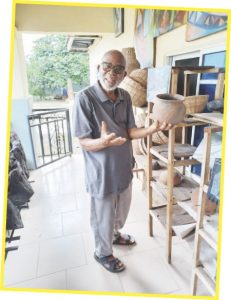
Obinna is a born artist from Umuocham, Emekuku in Owerri North Local Government Area of Imo State. His art gallery, situated at his hometown, has one of the ancient and modern collections ranging from historic paintings, relics and fossils of domestic and wild preserved animals, which he described as “Taxi Damy”, as well as sculptures, among others.
For him, art is a passion which he still indulges in. He has been an adjudicator in the famous Calabar Canival, a position that pushed him to the limelight before he was noticed by the former governor of the state, Chief Ikedi Ohakim, who encouraged him to remain part of the annual Ahiajoku festival. He is presently a member of the Central Planning Committee and Chairman, art and exhibition of this year’s event.
“I have been called upon to interpret and explain the Ahiajoku logo in this year’s event. This is the first time I would be given such opportunity, despite the logo being used on so many occasions without any deserved reward to it. I will only commend Chief Ikedi Ohakim who gave me a token as an honour for the creation.”
But as excited as Obinna is to be part of the historic Igbo event, he has expressed fears that art and culture may go into extinction if urgent steps are not taken by the government to reinvigorate it in school curriculum.
“I must have to also let you know that tourism and art is dying in the country with little or no recognition to it again. They’re not encouraging art. Look at the hospitality industry we have in Imo for instance. We have so many hotels but how many of them have genuine paintings and art work? But go abroad, you’ll see these beautiful art pieces adorning every building. I was expecting to see great paintings to accompany the beautiful flyover constructed by Governor Hope Uzodimma to make it look more beautiful and unique but it’s not there. It’s only at the Warehouse where paintings of former governors of the state are displayed. This is what I’m talking about.”
Obinna also lamented the death of craftsmanship in schools which he said contributed immensely in the local economy in the 80s.
“I was born and encouraged by my father and my mother. My mother died a musician. She died playing the organ, my father was a head teacher and headmaster. He had also the whip, and within this period, he was making sure that there was handcraft and handiwork which is lost in our system , I’ve written to government to allow me do what Mbakwe did, permitting me to go back to the elementary schools to teach at least one teacher in every elementary school to teach the children using the material that’s within their environment like baskets. These are beautiful things we used to have as handcraft. We also have the storage made from palms. We don’t use plastic trays and buckets to farms then. The children were doing it then. Vegetables coming from the north are packed in baskets. We send the basket to them , and they use it to bring back our food here. We should be mass-producing them but the craft is no longer there. I want to go back and teach teachers craft to teach the children because I did it during Mbakwe. If you go to areas like Okigwe, they are doing pottery because there is clay. These are clay pots used during the old days.”
While he still has a lot to offer at his age in tourism, art and culture, unfortunately, he regretted that he’s not getting the collaboration he expected from the state government and stakeholders in the art world.
“Let there be meaning to their collaboration not by words but let it be that we have done things for the greater being of the children because we want to take foundation education to elementary schools. This gallery wants to bring children here to train and make them happy, give them knowledge in art, history and creativity. The traffic has to increase. I’ve gone to galleries abroad. I paid 50 Euros to enter a gallery in Paris, I couldn’t even get a space because the day I booked have been overbooked. The works here are like having 50 people living in one room. These are portraits, they’re on the floor but they’re supposed to be hung. Is that how to see works of artists in a gallery? There are historical paintings here.”
He’s also appealing for the expansion of his gallery which has so much collection but stuck in a small building so that schools and individuals who have been coming for excursion will have a better space and good environment to study and spend their quiet times.
“I would be inviting the children on Christmas day to have a nice time here. They would be showed round the gallery, play games and have gifts. It’s part of my yearly celebration with the children. Other days are during my birthday and Children’s Day,” Obinna said.
The post Arts, culture may soon go into extinction –Pa Obinna appeared first on The Sun Nigeria.