From Sola Ojo, Abuja
For the ordinary Nigerian citizens, the 2027 general elections should not be a leading discussion in the country by mid-2025. They want to see how far the current administration of President Bola Tinubu can go in addressing the country’s multiple socioeconomic crises, especially improved security and a favourable economy for all. But for the top political echelons, political alignment, realignment and recalibrations are in full swing across party lines.
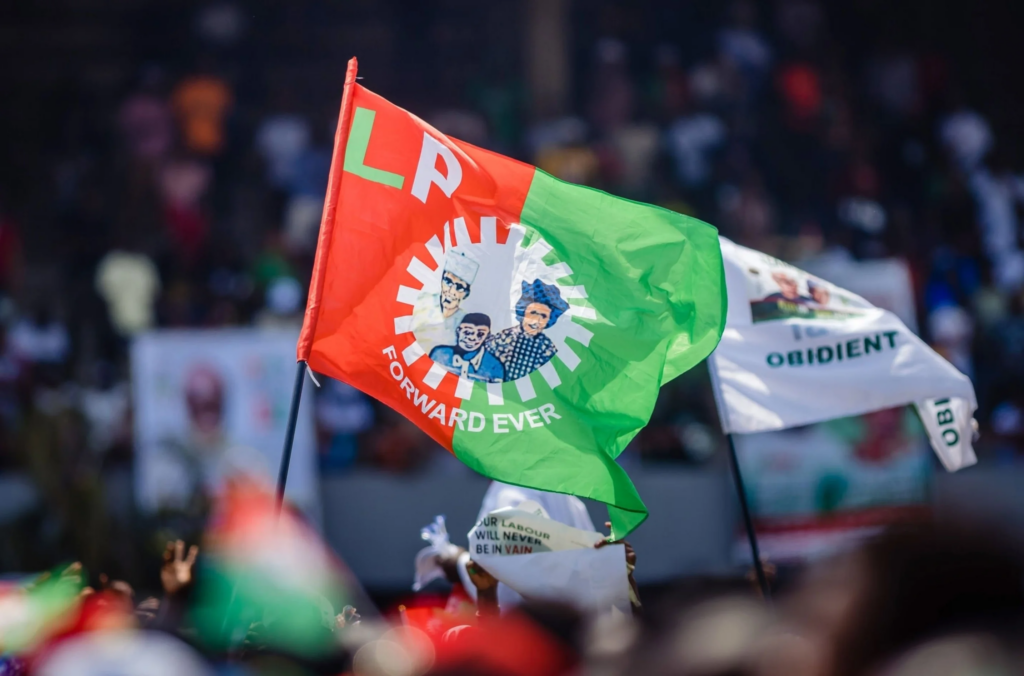
Among the most intriguing battlegrounds is the Labour Party (LP), whose dramatic rise in the 2023 elections disrupted the traditional two-party dominance of the All Progressives Congress (APC) and the Peoples Democratic Party (PDP). Yet, barely two years later, internal strife, leadership rivalries, and strategic uncertainties are threatening to undermine the party’s newfound influence despite scaling through the high courts, the Appeal Court and the Supreme Court.
googletag.cmd.push(function() { googletag.display(‘div-gpt-ad-1718806029429-0’); });
As the name implies, the party was originally registered by the union arm of the Nigerian civil servants until the 2023 general election, when it featured Mr. Peter Obi as its presidential candidate. However, several key players like Julius Abure, the embattled National Chairman, Senator Nenadi Usman, representing a factional alignment that is gaining traction, Yusuf Datti Baba-Ahmed, the 2023 vice-presidential candidate whose influence is both ideological and strategic, and, of course, Peter Obi, the LP’s presidential standard bearer in 2023, whose next political move could decide the party’s future, are now flexing muscles which may once again pave the way for the ruling All Progressives Congress (APC) in the coming elections. Add to this is the growing influence of the African Democratic Congress (ADC) and the persistent pull of the PDP. The picture becomes a fascinating study in political brinkmanship, observers say. Until now, the genuine interest of all the contending forces is sceptical.
Abure, not losing guard despite rejection
Daily Sun findings indicate that Julius Abure has remained the public face of the LP’s national leadership, holding firm even as his legitimacy is continually being challenged. For example, he appears to be fully in charge of the party’s national secretariat, Utako, Abuja. While he and his loyalists enjoy the facility for their meetings, other factional leaders and their loyalists must hire venues for their engagements. One of the reasons they gave was to follow due process in sending Abure parking from the Labour House.
Undoubtedly, Abure-led leadership has been marred by allegations of highhandedness, unilateral decision-making, and financial opacity.
“Detractors’ within the party accuse him of hijacking its structures and sidelining core stakeholders who powered the party’s 2023 ascendancy,” a member of the party said.
In April 2024, an internal revolt by the Nigeria Labour Congress (NLC) which is constitutionally affiliated with the party, led to forming a parallel transition committee and intensified calls for Abure’s resignation. The NLC’s President, Comrade Joe Ajaero, was blunt in stating that Abure’s tenure was not representative of workers’ interests.
As a matter of fact, Ajaero has been sighted at different fora, identifying with team Peter Obi, Alex Otti and Nenadi Usman, signalling the NLC’s total disapproval of the Julius Abure-led leadership of the one-time third force political party in the land.
For Abure however, invoking court orders, and securing loyalty from some key figures in the party’s National Working Committee (NWC), his strategy has largely been survivalist, relying on legal technicalities and intra-party elections to retain control. Yet, his continued grip has come at the cost of party cohesion, stakeholders argued.
For many within LP, the Abure factor is both the anchor and the albatross; offering organisational stability on one hand, but alienating reformist and ideological purists on the other.
Nenadi Usman as factional NEC Chairman
Senator Nenadi Usman, a former Minister of Finance and PDP stalwart like many other party members, represents a new but less-discussed alignment within LP. She has been accused of not being a card-carrying member of the party and a political distractor. While she has not declared open leadership ambition, Usman is said to command significant influence among members of the party’s Board of Trustees and financiers sympathetic to a centre-right ideology. For example, the only LP Governor, Alex Otti, his deputy and most of the elected senators and House of Assembly members are in her camp.
Arguably, her presence speaks to a broader infiltration of LP by actors who see the party not as a revolutionary vehicle but as a pragmatic alternative to a troubled PDP. Those with that thought, Daily Sun gathered, may be right, as the once-upon-a-time strong opposition party is now a shadow of itself due to lingering internal crisis. These forces favour a more moderate approach, transactional politics, and possibly even a 2027 alliance or fusion with like-minded parties.
She may emerge as a kingmaker rather than a throne-seeker.
The Datti Factor
Recently, Yusuf Datti Baba-Ahmed was widely reported after being sighted attending the Abure-led leadership NEC meeting in Abuja, to have dumped Obi in the LP leadership tussle. Although, he has said his presence at that meeting was towards resolving the lingering issue in the party, Datti is always with Peter Obi, being his presidential running mate in the 2023 presidential election. As it stands, he remains a wildcard in the LP equation.
Datti enjoys substantial goodwill among the youth base and the ‘Obidient’ movement. He also has political capital in the North-West, especially among progressive-minded elites and young professionals. If Obi stays in LP, Datti will likely get his role back as running mate. But if Obi leaves or is pushed out, Datti could either emerge as a consensus presidential candidate as he declared his intention to do so during his last public outing, dramatically reshaping LP’s 2027 prospects. However, with other political parties zoning their presidential tickets to the south, his chances may be very slim.
Peter Obi
Peter Obi remains the party’s most potent political asset and its biggest headache considering how his 2023 campaign redefined Nigerian electoral politics. In that era, he energised millions of young voters, challenging entrenched narratives, and winning over previously apathetic citizens. In the build-up to the 2023 election, Obi had millions of young people following and supporting him on social media, especially the ‘X’ space (formerly Twitter). Many, before that election, mocked him, arguing that social media supporters do not translate to voters. In his case, it did. He secured good votes from young persons and women, especially in the South-East, South-South, South-West, North Central and a part of the North-West, especially Southern Kaduna. He could not secure many votes in the core North-West and North-East due to poor political structure and party agents.
Obi has over and over expressed frustration with the party’s lack of internal democracy, disorganised structure, and the “cash-and-carry” politics creeping into its leadership. At a point, the party was accused of working for the APC, bearing in mind his “we no dey give shishi” campaign.
In several media appearances, he emphasised that his commitment was to “a new Nigeria” and not to any political platform. In that, he meant to have a political landscape with people as the focus.
Rumour mill has it that ‘A New Nigeria is Possible’ campaigner may return to his former party, PDP, especially if he is assured of a level playing field, even though his 2023 defection from the same PDP was driven by frustrations with alleged weak internal democracy, money politics, and ideological emptiness. But, all hope for the party may not have gone, especially as the former Kwara State Governor and former President of the Senate, Dr Bukola Sarki, is championing a reconciliation move to put the party in a formidable position once again.
Pundits argue that if Obi returns to the PDP, it would be regarded as homecoming.
“But he should not forget that, in recent times, a lot of elected politicians, including a governor and about 40 lawmakers, have left PDP for APC, and several others are in the waiting room to follow suit.
“The ADC was also seen as a potential fallback, given its ideological leanings and youth-focused outlook. However, recent developments suggest that the ADC is unlikely to hand Obi the presidential ticket on a platter, like he enjoyed in the LP in 2023.
“Apart from the fact that the coalition party has recorded an influx of high-profile politicians like David Mark, Rotimi Amaechi, Nasir El-Rufai, among others, ADC, like LP, currently lacks the national spread and structural strength that Obi would require to mount another credible challenge in 2027. It is also crucial to add that, whatever the case, 2027 will signal the last four years for the South to lead the country. By 2031, North will be ready to take a shot. But, since this is not a constitutional matter, anything can happen, “ one of the party leaders said.
Daily Sun gathered that as things stands, Obi’s best bet remains a reformed LP. And that all that is required is for the warring parties to compromise their positions, return to the negotiation table and provide a credible alternative force for the electorate.
Should the party fail to resolve its internal contradictions, however, Obi, observers added, may have little choice but to either form a new coalition or join a new party entirely, which would have major implications for the political landscape and electorate trust.
As Nigerians await the outcome of the lingering crisis in LP, so many questions are already agitating their minds. These are: will the party maintain its reformist, anti-establishment stance while accommodating experienced politicians like Nenadi Usman and their transactional style? Will Julius Abure sacrifice his leadership ambition to become more receptive and inclusive in the interest of the party and Nigerians? Will Peter Obi decide to stay put and take charge of LP internal restructuring knowing full well that the party is now strengthened around him? It seems only time will tell. However, the coming months will be crucial to determine whether the party will mature into a credible alternative, or become another footnote in Nigeria’s emerging history of failed third-force movements.
The post Obi, Labour Party and politics of 2027 appeared first on The Sun Nigeria.