
By Adewale Sanyaolu
To achieve Nigeria’s ambitious $1 trillion economy target, the Society of Petroleum Engineers (SPE) Nigeria Council has stressed that increasing oil production to the national goal of 2.7 million barrels per day (mbpd) by 2030, alongside fully harnessing the country’s 209 trillion cubic feet of gas reserves as the preferred transition fuel, are imperative and non-negotiable.
googletag.cmd.push(function() { googletag.display(‘div-gpt-ad-1718806029429-0’); });
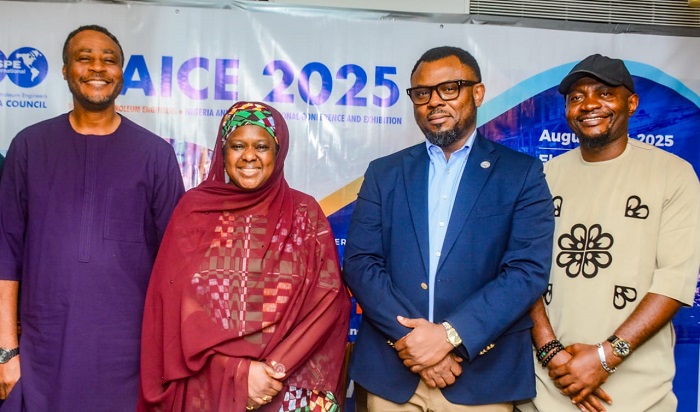
SPE Nigeria Council Chairman, Dr. Amina Danmidanmi, disclosed this at a press conference for SPENAICE 2025 holding in Lagos from August 2 to 6.
Achieving these targets, SPE noted, will require enhanced field recovery, gas monetisation, infrastructure reliability and pipeline security.
To this end, she explained that SPENAICE 2025 will showcase technical insights and practical solutions that support Nigeria’s energy security and economic growth goals.
The SPE Nigeria Council leader said the theme for this year’s conference, “Building a Sustainable Energy Future: Leveraging Technology, Supply Chain, Human Resources, and Policy,” is a call to action for the oil and gas industry and our nation.
According to her, globally, energy systems are transforming under the twin pressures of climate imperatives and technology shifts.
On the local scene, she said Nigeria faces the task of balancing economic growth, energy security, and the global transition to low-carbon solutions.
Danmidanmi, however, said SPENAICE 2025 comes at a critical moment for Nigeria’s energy industry—a moment of transition, opportunity, and responsibility.
Over the past year, she stated that Nigeria has witnessed historic divestments by international oil companies from onshore and shallow water assets.
This, she said, is a defining chapter in our energy story because it tests the capacity of indigenous operators, demands retention and redeployment of human capital, and creates opportunities for deepening local content and technical independence.
However, she said SPE Nigeria is responding by providing neutral platforms for knowledge exchange, equipping professionals for the operational and commercial realities of new asset ownership, fostering collaboration between local operators, service providers, and global technology partners.
On gas, infrastructure, and the path to sustainability, Danmidanmi said Nigeria’s gas wealth is the bridge to a lower‑carbon economy.
“Gas monetisation for power generation and industrial use is essential to our energy security. Pipeline infrastructure and processing capacity must expand to capture flare gas, enable exports, and support the domestic market.
On the conference, she said NAICE is more than a conference but West Africa’s premier meeting point for energy innovation, policy dialogue, and professional excellence.
“This year, we expect over 4,000 participants from across Nigeria and the global energy ecosystem, more than 80 exhibiting companies showcasing cutting-edge solutions, and two high-level leadership panel sessions, alongside youth and family programs, technical courses, and social engagements.
She added that the theme challenges SPE to connect four critical pillars: technology, supply chain, human resources, and policy.
“From digital oilfields to enhanced recovery, modular gas processing to pipeline surveillance technologies, technology will be the engine of efficiency and sustainability.
Strengthening local content, building resilient, cost‑efficient project delivery systems, and reducing dependence on imports and FX pressures.
Retaining and retooling Nigerian talent in the era of energy transition, providing youth pathways, technical upskilling, and inclusion for women.
Aligning regulatory frameworks with investor confidence, supporting the $1 trillion economy aspiration, and ensuring Nigeria’s energy policies are globally competitive and locally relevant,” she said.
She added that this year’s edition will be exceptional because it is designed to stand apart from every previous NAICE through top-level leadership panels which bring together regulators, operators, financiers, and innovators to chart a cohesive energy roadmap.
“Our youth and family programs, including mentorship initiatives, will nurture the engineers and innovators of tomorrow.
NAICE 2025 is featuring over 80 exhibitors with solutions spanning digital energy, enhanced recovery, and low-carbon operations,” she added.
The post Petroleum engineers unveil strategies to drive Nigeria’s $1trn economy appeared first on The Sun Nigeria.