From Sola Ojo, Abuja
On their faces, you’d see courage, determination and hope strong as steel. They are the stone breakers of Kujama.
In the banditry-ridden village of Kujama in Chikun Local Government Area of Kaduna State, the sharp crack of hammers on stone echoes through the air each day, not as a symbol of suffering, but one of survival.
googletag.cmd.push(function() { googletag.display(‘div-gpt-ad-1718806029429-0’); });

Here, a group of determined men, about 30 of them, have chosen a gruelling life of manual quarry work over the lure of drugs or crime, carving out a future from boulders and grit in a country where opportunities remain scarce, especially for those not born with a silver spoon in their mouth.
Amid the northern bright sun that continues to smile on them, torrential rainfall that bedraggles them like tick forest eagles and the weight of neglect, these men stand tall, not as victims, but as examples of what it means to live with dignity against all odds.

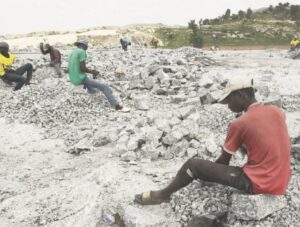
With no machines, no external support, and little recognition, these men break large stones with fire and wooden sledgehammers into the different sizes required by builders.
This is a physically demanding process that takes days and yields unpredictable income. But behind the grit lies a deeper story of resilience, frustration, and the quiet pride of honest labour.
When this correspondent visited the site, located about 250 metres off the Kaduna-Kachia road, the men were busy with their hustle. At the same time, a few traders were also sighted providing food services for stone breakers and truck loaders.

Mr Lawal Kujama, one of the respected arrowhead who has worked in this site for five years, said, though many see it as one of the hardest jobs to do, it is putting food on their table and paying children’s education and medical bills.
He added that it is difficult to calculate their earnings per hour or day, as the process takes days and sometimes a week due to a drop in the demand for stones by the nearby builders.

“You can’t really calculate earnings by the day. This work is done in stages. First, you buy firewood, locate the layer, and burn it. That can take a whole day.
“Then you return another day to remove the cooled stones and later start breaking them into smaller pieces,” Kujama said.
So, it typically takes a week to finish a single batch, and only after that can they hope to make a sale. The stones are sorted based on their uses; “Yeska” for concrete casting, “Dugudugu” for lintels, and the bigger “hardcore” used for roads and foundations.
According to Kujama, a full truckload (mini cabin) sells between N12,000 and N30,000, depending on the type, excluding loading and transportation costs, which depend on distance.
But despite the hard work, the earnings barely cover needs, coupled with the many challenges.
To Kujama, “the biggest challenge is during the rainy season. If rain comes while the stones are being heated up, the firewood is wasted. That’s money gone, and you have to start over.”
For Daniel I. John, who has spent two decades in this line of work, quitting was never an option.
“No, I have never quit and I won’t quit by the grace of God. I enjoy the protection and strength He gives me.
“This job has helped me. Whenever I need something, I use the money from this work to solve my problems”, he said, with his eyes fixed on the hips of stones close by.
Daniel, who also plays the guitar in his spare time to relax and reflect, sees the job not just as a means of survival, but a moral stand.
“I don’t see any value in kidnapping, stealing, or doing bad things just to survive or belong as they call it.
“Even if crime gives you money, it won’t give you peace of mind. That’s why I prefer to hustle and work hard, even if people call it suffering. To me, it is living my life,” he stated.
But not everyone sees the quarry workers with that same lens of dignity.
According to Nathan Idoko, another stone worker in this site who hails from Cross River State, the perception of the stone breakers by the society and the lack of support from government agencies are a constant weight.
“In this village, many young people passed through here waiting for government jobs.
“But the truth is, without someone in the system to help you, there is no opportunity. Even if you travel abroad and come back, nothing changes without connection”, he decried.
He and his peers decided not to wait for handouts. Instead, they pooled their skills and limited resources to make something of their lives.
“Some of our friends say they can’t do this kind of hard work. They prefer to stretch their hands and wait. But we refused. We said let us use what we have, even if it is small”, Nathan said, wiping sweat from his brow.
He continued: “People look down on us because of the work we do. But many of us are educated. We tried everything. When we saw there was no help coming, we turned to this small work to survive.”
He further stressed that the stigma went deeper, with assumptions that those in manual labour are into drugs or crime.
“That’s not true. We are using our personal strength and determination to survive, not hard drugs”, he added.
One of the amazing things in this encounter was that, despite their own hardship, the Kujama quarry workers still give back their widow’s mite.
“Sometimes, we contribute small money to help widows and orphans in our community. You know this is one of the areas that suffered insecurity in Kaduna State. It is not plenty, but it comes from our hearts”, he said.
Asked what he would do if he had support, Nathan’s answer was immediate, “I would buy a machine to make the work easier and expand the business.
“I’ve thought about it a lot. With the right support, this work could change our lives.”
But for now, they continue their job with hammers in hand, hope in their hearts, and a steely determination etched into their calloused palms.
The post We chose hard work over drugs, crime –Kujama stone breakers appeared first on The Sun Nigeria.