
From Noah Ebije, Kaduna and Olanrewaju Lawal Birnin Kebbi
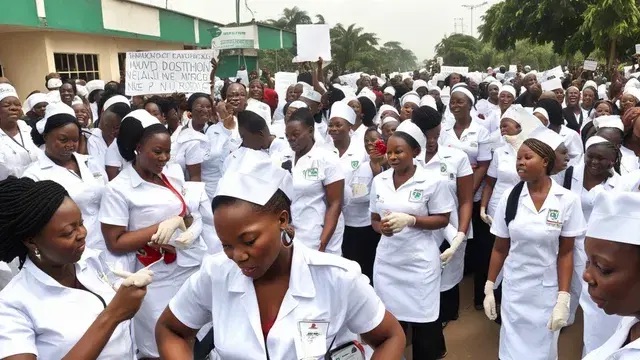
The National Association of Nigerian Nurses and Midwives (NANNM) has told the Federal Government to accede to its demands to ensure improvement in healthcare delivery in the country.
Secretary of the Lagos State chapter, Mr Oloruntoba Odumosu made the call in Lagos as the industrial action enters the third day.
googletag.cmd.push(function() { googletag.display(‘div-gpt-ad-1718806029429-0’); });
Nurses under the aegis of NANNM had embarked on a seven-day warning strike on July 30 to press home some demands following expiration of a 15-day ultimatum the association gave to the government. The action has paralysed healthcare services nationwide, leaving patients stranded and putting pressure on other health professionals.
Meanwhile, Mrs. Josephine Bassey, chairman of the Cross River State chapter of NANNM, has said 90 percent of the demands to the Federal Government carry no financial implications.
Speaking in Calabar, Bassey explained that most of the demands revolved around administrative issues such as implementing policy papers and enforcing court judgments.
She added that another key demand was the gazetting of long-standing approvals by the National Council on Establishments.
“Our demands include the gazetting of the nursing scheme of service approved since 2016 and the creation of a Department of Nursing in the Federal Ministry of Health.
“Another key demand is the centralisation of internship for nursing graduates.”
She added that other demands include the review of provisional allowances for nurses and midwives, as well as the appointment of nurses to the boards of federal and state health institutions.
She also stressed the urgent need for the employment of more nurses due to severe staffing shortages.
Bassey noted that compliance with the strike directive on the second day was total, with 100 percent participation recorded on the first day.
“We started as early as 7:30am to monitor all health facilities across the state to ensure full compliance,” she said.
According to her, any nurse found violating the strike directive would have been forced out of work and sanctioned at the national level.
“Nurses make up about 60 to 65 percent of the healthcare workforce.
“If the government truly appreciates the critical role we play in healthcare delivery, it should address our demands promptly,” she stated.
She acknowledged the impact of the strike on patients but urged the public to speak up in support of nurses.
“We feel the pain of the patients, but we also urge them to cry out on our behalf to well-meaning Nigerians and the government, so our concerns can be addressed,” she said.
Bassey added that nurses would immediately return to work once their demands were met.
Odumosu said the government was to hold a meeting with national leaders of the union at press time yesterday to dialogue to resolve the issues leading to the warning strike.
He said the outcome of the meeting would guide the association’s next line of action.
“Because it is a national issue and a national strike, we are not engaging the Lagos State Government; we can only put pressure on the Federal Government to listen to us.
“These demands have been long overdue; some of them are things that are four decades old.
“Ordinarily, we should have lost patience a long time ago. This is the first time the association has gone on strike as NANNM in over two decades.
“Before we called for this strike, we had given the government an ultimatum which it failed to address; rather, it was addressing the Nigerian Medical Association (NMA) and meeting with the members.”
He said that nurses were the largest professional group in the health sector, urging the government to meet the demands.
“We want to stop brain drain, but we can’t if the policies are not there to address our concerns.
“We appeal to the government to accede to our demands quickly so that we can end this needless suffering and loss of lives among patients,” he said.
According to him, monitoring teams are on ground in all Lagos primary, secondary and tertiary public hospitals to ensure full compliance with the industrial action.
As the industrial action enters its third day, absence of nursing staff across federal government health institutions nationwide has left patients stranded.
Patients are facing the realities of a system paralysed by a nationwide strike by nurses, a family member of a patient told Daily Sun at the National Ear Care Centre, Kaduna.
When Daily Sun visited the hospital yesterday, patients on admission were seen struggling without basic nursing care.
A patient, Peace Agadama, recounted her ordeal amid tears and visible discomfort. “I was diagnosed with acute sinusitis and a bacterial infection affecting one part of my head. I can’t feel anything on this side,” she said, pointing to the left part of her face.
“The pain is excruciating, there’s a foul-smelling discharge and constant needling headaches.
“For the past two or three days, it’s been terrible. There’s nobody to assist with simple tasks like changing my cannula. The doctors are doing their best, but they’re overwhelmed. I’ve had my cannula changed four times in two days. Both of my hands are swollen. There’s no one to assist when I need to use the restroom or need immediate help.”
She added that some patients were even discharged prematurely due to the lack of manpower.
“I overheard doctors saying, ‘discharge everybody,’ because there are no hands on deck. Some people were sent home before they were fully treated…”
Nurses are essential to healthcare. If they’re not around, lives are at stake. We’re pleading with both the nurses and the government to find common ground. Nurses don’t just deserve what they’re demanding, they need it to function properly. This affects all of us.” The Head of Department, Nursing Services at the centre, Abbas Daura, confirmed that the nurses had fully withdrawn their services, save for emergencies—which, he noted, had been few since the commencement of the strike.
“You can see the situation yourself. Nobody is happy. The patients are at the receiving end. They’re not getting the satisfactory services they deserve. The strike is a complete withdrawal of services, although we still attend to emergencies…?
But honestly, since the strike began, we’ve not had any such emergency cases.”
Daura lamented the long-standing issues plaguing the nursing profession in Nigeria, especially the harsh working conditions and lack of basic facilities. He said these were responsible for the alarming rate at which Nigerian-trained nurses are fleeing the country for better opportunities abroad.
“We have the knowledge, skills, and training. Our institutions produce some of the best hands in healthcare. Unfortunately, it is foreign countries that end up benefiting from our expertise because we can’t work in an enabling environment here.”
He called on the Federal Government to rise to the occasion and address the grievances of the striking nurses.
•Preferential treatment
At the Federal Medical Centre (FMC) Owo chapter, nurses have vowed not to render services to patients during the seven-day warning strike irrespective of the case.
Mr Coker Oluwasegun, Secretary of the association in the chapter, accused the Federal Government for not addressing the plights of nurses.
“It is total compliance. No leeway whatsoever. The Federal Government has unfairly treated nurses over the years and here is the time for us to take the bull by the horn.
“So, the fight is not against the management of Federal Medical Centre Owo as we had rightly informed the Medical Director and his team.
“For more than two decades, uniform allowance remains N20,000 per year and in all other allowances, nurses get the least despite the fact that we are the major work force in the health sector.
“No equipment to actually work with in most of our hospitals making patients to see us as the one killing them. No good working conditions and environment.”
He said there were a lot of failed promises from the part of the Federal Government, stating that the warning strike would continue for seven days.
“If our 12-point demands are not met, we will resume at the expiration of the seven-day warning strike.
“Then, we will give the Federal Government another 21-day ultimatum before an indefinite strike will commence,” he said.
•NANNM chair apologises, urges action
Kebbi State chapter of NANNM has apologised to Nigerians over the ongoing nationwide warning strike by nurses.
Its chairman, Kilani AbdulWaliyu, made the plea while addressing journalists in Birnin Kebbi in response to the one-week industrial action.
“I want to use this medium to apologise to Nigerians, especially our patients. We understand the implications of withdrawing our services; we value lives. However, we are left with no option but to down tools,” he said.
“We are also feeling the pain of this decision. We are human, we respect human lives, and we know the possible consequences, including increased mortality.
“These are the difficult considerations we weigh before embarking on a strike.”
AbdulWaliyu appealed to Nigerians to pray for divine intervention, urging God to touch the hearts of leaders and prompt them to address the issues that led to the industrial action.
He emphasised that nurses, more than any other group, fully understood the consequences of a strike because of their direct role in patient care.
The chairman attributed the strike to the government’s failure to meet long-standing demands, including the gazetting of the nursing scheme of service approved years ago.
He noted that the continued delay in implementing the scheme had caused frustration among nurses and hindered progress in the profession.
He also highlighted the need for the centralisation of internship placements for nursing graduates, similar to practices in other professions.
The chairman said adopting the approach would promote fairness, streamline the process, and ensure equal opportunities for all nursing graduates.
He also highlighted critical manpower shortages, noting that many nurses were leaving the country for better opportunities due to poor remuneration and unfavourable working conditions.
AbdulWaliyu referenced a recent circular on the upward review of health workers’ allowances, saying it did not reflect the original proposals.
He noted that while the Federal Government withdrew the circular for revision, no concrete action plan had been communicated.
“After withdrawing the circular, what steps have been taken to address the underlying issues?” he asked.
He also decried the absence of a substantive Director of Nursing Services in the Federal Ministry of Health, saying the current structure did not allow for full autonomy or effective coordination.
“It’s unimaginable that with more than 20,000 nurses under one person, that individual operates without full authority, under another director.
“How do you ensure unity of command in such a system” he questioned.
AbdulWaliyu noted that the union had taken proactive steps by issuing a warning and an ultimatum prior to the strike, demonstrating their willingness to engage in dialogue.
He expressed optimism that with constructive engagement, the Federal Government would take the necessary steps to address the union’s concerns moving forward.
The post …90% of our demands have no financial cost –Union appeared first on The Sun Nigeria.