
From Ismail Omipidan, Abuja
The National Institute for Legislative and Democratic Studies (NILDS), which started off as Policy Analysis and Research Project (PARP), in 2003, before metamorphosing into full-fledge institute in March 2011, has its core mandate cut out for it. But experts believe that, with the personality and character of the current leadership of the institute, the mandate could be expanded to cover raising future transformational leaders that would have development as their primary objective.
As an arm of the National Assembly, the Institute’s primary responsibility is to support and strengthen the country’s legislature in pursuit of the ideals of democratic governance, through research, advocacy, teaching, networking among others.
googletag.cmd.push(function() { googletag.display(‘div-gpt-ad-1718806029429-0’); });
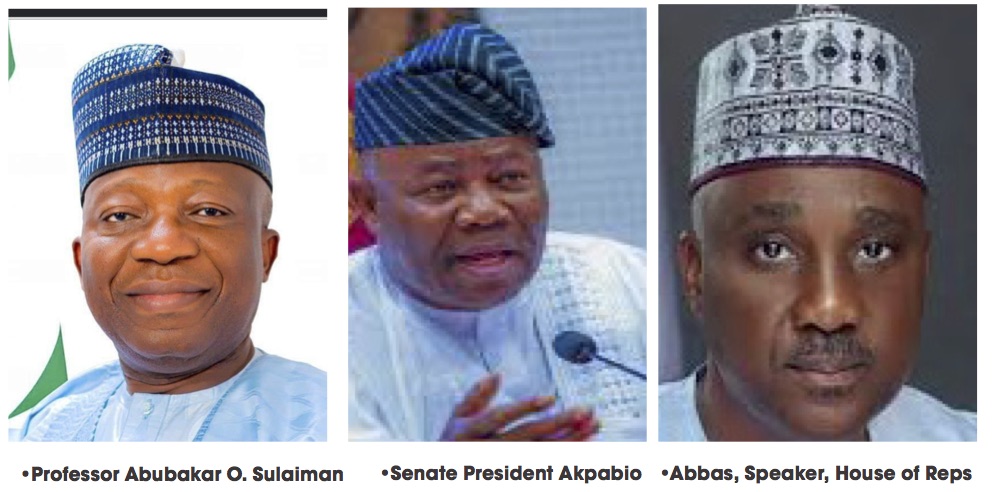
Since the assumption office of office of the current Director-General (DG) of the Institute, Professor Abubakar O. Sulaiman, six years ago, he has been making frantic efforts to get the 36 state governors to key into the vision of the Institute, so as to reduce foreign trips that most state lawmakers embark upon in the name of capacity building and training.
Apart from getting the buy-in of state governors, the DG has equally made efforts to transform NILDS to one that is result-oriented. To situate his impact in the Institute, a symposium was put together recently to examine his leadership of the Institute in the last six years.
Themed “Reflecting on the Six Years of Impact: A Symposium in Honour of Prof. Abubakar Sulaiman, DG of NILDS,” the occasion was attended by several distinguished guests, including the President of the Senate, Senator Godswill Akpabio, who was represented by Senator Victor Umeh; the Clerk to the National Assembly, Kamorudeen Ogunlana; former Deputy Speaker of the House of Representatives, Rt. Hon. Emeka Ihedioha; Mr. Linus Okorie; the Acting Vice Chancellor of Yakubu Gowon University, Professor Manko Lar; as well as members of civil society organisations, the academic community, and other critical stakeholders.
Speakers and stakeholders on the occasion, called for reasonable investment in building transformational leadership to enhance national development. Linus Okorie, founder of GOTNI Leadership Centre, in his keynote address emphasised the need for transformational leadership if Nigeria must attain the desired development.
According to him, transformational leadership is a leadership concept that places a premium on people and is inspired by a compelling vision, strengthened by upholding sound principles, which change both the leader and the followers.
While describing Nigeria as a nation with abundant resources, vibrant population and an enviable geo-strategic position in Africa, Okorie however noted that for national transformation to happen, leadership must go beyond positional authority to purpose-driven impact.
“In the end, nations do not change because of the abundance of resources or the eloquence of policies; they change because of the intentionality, integrity and imagination of those who dare to lead differently,” Okorie said.
And he was quick to add that the NILDS DG possesses the qualities listed above. Hear him: “Sulaiman embodies these qualities. His work at NILDS reminds us that institutions can work, that excellence is possible and that leadership still matters. May his legacy inspire many others across the country.”
Also speaking on the occasion, the Executive Director of Yiaga-Africa, Samson Itodo, urged Prof. Sulaiman to work towards an intellectual solution to the indiscriminate defection of political party members.
He noted that though the Supreme Court had ruled that votes belonged to a party, those who still defected from one party to another were not leaving their office.
Similarly, he called on the Institute to do more to ensure women’s inclusion in politics, leadership, and all other sectors of the country, just as he urged the NILDS DG to push for electoral reforms and the passage of a new Electoral Act before the end of the year.
On his part, the Country Representative of Westminster Foundation for Democracy, Adebowale Olorunmola, noted that Nigerians need to reflect deeply on the decades-long leadership crisis, saying that though Nigeria has many transformational leaders, the country was still far behind its peers in terms of development. And as such, investment was needed to build leadership capacity at all levels and in different strata.
“We need to invest in building our leaders that are there now, but we must also invest in future leaders, the people, the young people that are coming; that is the problem that we need to deal with,” Olorunmola added.
Eulogising the leadership being provided by NILDS DG, President of the Senate, Sen. Godswill Akpabio, said that the National Assembly takes pride in the performance of NILDS, led by Prof. Sulaiman.
Represented by a member of the Governing Council of NILDS, Sen. Victor Umeh, Akpabio lauded the leadership qualities of the DG, just as he described him as “dogged and resilient.”
“This institute, he has turned it around so much that anytime you drive into the premises, you know that you are walking into an ambience of a citadel of learning, where people’s minds are developed.
“For us in the legislature, this place is a place where the skills of lawmakers are honed. When you come here, you will understand basic symbols of lawmaking.
“And once you follow the guides and the lectures, they give you, you turn out to be a good lawmaker; the purpose of setting up this institute is very well realised under his leadership,” Akpabio added.
The clerk of the National Assembly, Kamaru Ogunlana, while making his contribution, said the strategic importance of the NILDS Director General’s role in the Institute cannot be over-emphasised, just as his pledged the bureaucratic arm of the National Assembly’s continued collaboration to support legislative reforms being pursued by the Institute, under Prof. Sulaiman.
“There is something some of you may not know. For you to hold the post he (the DG of NILDS) is holding in the National Assembly, President Bola Tinubu, Senate President Godswill Akpabio and Reps Speaker Tajudeen Abbas must be involved. If they are personally involved, then it means you have to personally pay close attention to your activities,” he added.
In his remarks, Professor Sulaiman emphasised that the celebration was not a conclusion but a reflection point, adding that “this occasion is not about drawing the curtain, but about taking stock of the journey thus far, so we are better positioned to achieve even more.”
He further stated that as NILDS looks forward to increased and timely budgetary allocations, the Institute remains committed to deepening its contributions to the growth and development of Nigeria’s legislative and democratic landscape.
While thanking that past and present leadership of the National Assembly for being supportive of his transformational and impactful leadership at NILDS, the professor of political science equally noted that despite attempts to cripple NILDS in the last two years by some individuals with vested interests, the leadership of the National Assembly had sustained the Institute.
“The Institute has the potential to survive. We have the potential to redirect this country. We have the potential to mentor the younger ones. The only thing we need is the willingness of our people to give us maximum support. As we look forward to getting higher budgetary allocations and timely release, NILDS will continue to do more to expand its contribution to the growth and development of our nation’s legislative and democratic system,” he said
The post NILDS, Transformational Leadership for development appeared first on The Sun Nigeria.