

Some years ago, the Nigerian political space was dominated by one mega party, which felt larger than life. Despite the fact that there were other political parties, most politicians were in or wanted to join the Peoples Democratic Party (PDP) at that time. Then, political developments in the country were always centred around defections to the PDP, especially close to general election. Politicians did defect and clustered around the PDP as ants do sugar. It was as if the PDP was the only political party in the world.
The popularity of the PDP at that time actually got into the heads of its leaders, at all levels, that arrogance had set in. Leaders of the PDP started misbehaving, disrespecting Nigerians and treating some of their members with disdain, to the extent that one of them boasted that the political party would rule Nigeria for 60 years. Implosion and coalition against the political became inevitable.
The arrogance of the PDP was so huge that even when the fusion of some political parties, including a splinter of the PDP, produced the All-Progressives Congress (APC) in 2014, the then ruling party refused to mend its ways. Not even the warning that if the PDP lost political power, it would take only the grace of God for it to bounce back could cause any change in the behaviour of the party’s leaders. It was a case of he who wants the gods to kill him or her, would first become deaf.
As they say, pride comes before a fall. The PDP’s pride did reach the zenith and the bubble eventually burst in 2015. The PDP not only lost power at the federal level, but also badly too nationwide. The party lost governorship elections in many states and the once almighty PDP, like Eneke the bird, which got overfed and challenged its god to a fight, became a political pauper in Nigeria. The PDP was reduced to a minority political party.
Since then, until now, things have not been well with the PDP. For the political party, things have fallen apart and the centre cannot hold. At the moment, the PDP is embroiled in a crisis that threatens it very existence. Every day, members of the PDP, including governors, are defection to another political party. Some people have predicted that it may be Nunc Dimities for the PDP.
The PDP golden era in Nigerian politics is history now. That history has not taught those who should learn any lesson. The problem with Nigerian politicians and political leaders is that they do not learn from history. For them, history is a mere documentation for the bookshelf and not for any lesson. The APC, which took over power two years ago, owing to PDP’s display of bad political judgment, has started exhibiting the same trait that led to the downfall of the former ruling political party.
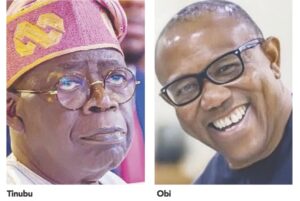
No doubt, the APC is having a ball today. The political party is in control of the federal government, with Bola Ahmed Tinubu as the president. APC has everything, so to say. It has the presidency, the National Assembly and controls 23 states, where governors elected on its platform or defected to it hold sway. The APC has become the political bride, sought after by all. These days, the political party receives members of other parties holding elective positions into its hold, in an avalanche of defections. Recently, two PDP governors joined the APC, with speculation and/or expectation that more would also join. Daily, federal lawmakers are leaving either the PDP or the Labour Party (LP) to join the APC. The APC is the political party of the moment, in the eyes of Nigerian politicians.
The good fortunes of the APC have made many people to fear that Nigeria is going to a one-party state, where APC members would be president of the federal republic, governors of the 36 states and federal and state Houses of Assembly lawmakers, with no other political party boasting of anything. The feeling is so strong that President Tinubu publicly declared that he was expecting more people to join the APC. He had boasted: “You don’t blame a people bailing out a sinking ship. I am expecting more to come. That is the game. We’re in a constitutional democracy that guarantees the freedom of movement and the freedom of association. Welcome to the progressives. Sweep them clean.”
President Tinubu may dream dreams of a one-party state. He could even boast of it. Politicians who think that the APC is the Promised Land may join the political party in droves. The indices may indicate that the APC would soon become a convergent point for political bigwigs. The power-that-be may coerce people to join the APC. Leaders of APC and other members may even gloat that only their political party guarantees victory at the polls. However, the political terrain in the country does not paint the picture that a one-party system is a fait accompli.
Politicians may move to other political parties for their political gains and safety, but what really determines the political party that is in control are the people. The political will of the people, who would exercise their franchise, determines the outcome of elections and the political party that would prevail. The APC may be under the illusion that a one-party state, where it would be the sole political party, is in the offing. However, going by the configuration of Nigerian politics today, other political parties would remain relevant.
No matter how tattered and the magnitude of crisis that engulfs PDP, it would remain a factor in the country’s politics. The PDP today has 10 governors, including the suspended Rivers State’s Siminalayi Fubara. The All-Progressives Grand Alliance (APGA), the LP and the New Nigerian Peoples Party (NNPP) each has one governor. The three political parties would remain factors. Also, the African Democratic Congress (ADC), which is a coalition of the “Tinubu-must-go politicians,” unorganised or bed of different bedfellows, is a factor. Peter Obi, presidential candidate of the LP in 2023, is a political movement. Nigerians, who are disillusioned by the conduct of political leaders, in and outside government, are a political force, in fact, the proverbial “People’s Party of Nigeria.” All these factors combined, and many others, make one-party state difficult.
In 2027, what would play out is a fight between the self-confident/arrogant APC and Nigerians. The world would see a contest between APC and the “People’s Party,” with Nigerians collectively declaring that enough is now enough about the shenanigans of politicians, who do not have their interest at heart. Resentment of northerners and southerners against the low-performing government at the centre could coalesce to a mass political movement at the polls, that would also see the people defending their votes.
In 2023, the “People Party” platform was manifest and proved that the people’s structure is the most potent political tool in an election. In Zamfara State, Governor Dauda Lawal of the PDP, was the underdog in the governorship election. He ran an election, where everybody who mattered in the political echelon of the state, was in the APC. Although a candidate of the PDP, Lawal worked with the “People’s Party,” making the people the centrepiece of his political aspiration. The people came out in mass to support him. The majority of the people voted for him on election day. The people stood to make sure that their votes counted. The people’s choice prevailed and Governor Lawal is in office.
It is also the “People’s Party” that made Obi the political force he has become in the country. Like him or hate him, Obi has become an irresistible force in the country’s politics and the fear of him by his opponents is the beginning of political wisdom. It is a record that Obi, who contested on the platform of a relatively unknow political party, without a single governor or elected lawmaker, was able to garner six million votes, with many people still believing that he may have scored the highest number of votes in the presidential election irrespective of what was declared.
The true “People’s Party,” which does not need the registration of the Independent National Electoral Commission (INEC) to operate, was the back bone of Obi, Lawal and others who made marks in the 2023 elections, against all odds. That political movement is still in place and would come into play in the next general election. This would frustrate a one-party state plan. Indeed, as long as Nigeria’s diverse cultural, ethnic, and religious idiosyncrasies are factors in the country, a one-party state would not fly. Also, with the media and civil society groups remaining vibrant and continuing to expose the challenges of attempts by the APC to suppress opposition or establish a monarchy, a one-party state would not work out.
Going by the low rating of the government at the centre, APC’s actions would continue to face significant public backlash and potential loss of support. Just like PDP was not, the APC can’t be invincible. What is needed is for the opposition to keep playing its cards and well too. A coalition among political elements, groups and interests is needed in 2027. When opposition coalition is fused with the force of the people, who are ready to resist electoral manipulation and election opacity, one-party state plot and dream would crumble. No matter how difficult it may seem, defeat of an incumbent is still possible in today’s Nigeria.
The post APC’s one-party dream vs the ‘People’s Party’ appeared first on The Sun Nigeria.