
By Enyeribe Ejiogu
“The care of human life and happiness, and not their destruction, is the first and only object of good government.” —Thomas Jefferson, former US President, March 31, 1809
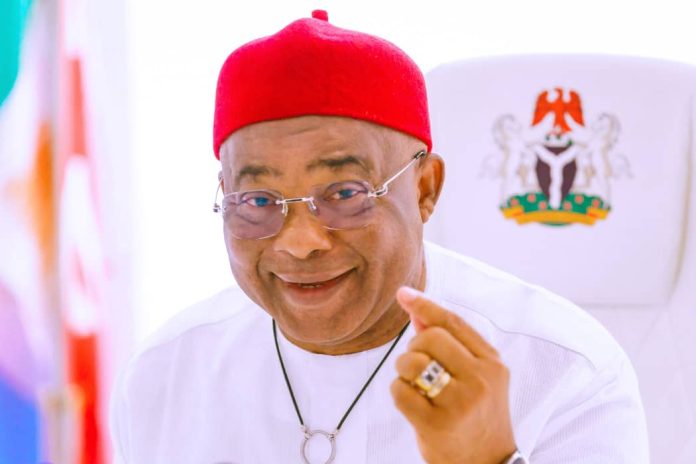
Imo State Governor and Chairman, Progressives Governors Forum, Senator Hope Uzodimma, has hit a high note.
googletag.cmd.push(function() { googletag.display(‘div-gpt-ad-1718806029429-0’); });
He has set off a firestorm and created a tsunami of demands by people in several states of the country, calling on their governors to follow Governor Uzodimma’s footsteps.
He detonated a bomb in the education system a few days ago. The fallout left proprietors of private schools hastily adjusting their 2025/2026 budgets. Today they are squirming and shifting with anxiety, watching a source of extra income evaporate like methylated spirit rubbed on the back of the palm.
On the other hand, parents and guardians hard-pressed by the worsening state of the economy have been applauding the governor’s decision and saying, “Yes, this is a big relief for us.”
The statement by the Imo State Government banning private schools from making parents and guardians pay hefty levies, to cover the cost of organising parties for pupils passing from nursery into primary school, primary 6 pupils going on to JSS1 and JSS3 students going into SS1, is the reason for the joy and excitement.
In the past, passing out from nursery to primary, sitting for the Common Entrance examination to gain admission into secondary schools, and then sitting for the Basic Education Certificate Examination, BECE, written by JSS3 students was a common, routine practice that elicited no fanfare.
This remained the situation until some private schools wanting to be different and more appealing to attract the parents of new prospective pupils introduced low—budget parties. Parents initially welcomed the parties, but economic realities have hit over the last few years.
The cost of holding the parties has increased so much as some schools introduced competition into the organisation of the event. Some would engage known influencers and popular on-air-personalities to be the comperes. They would hire caterers and compel parents to pay for special graduation uniforms and specially designed yearbooks featuring the pictures of their wards. Naturally the cost of these embellishments shot up, blowing holes in the pockets of hapless parents buffeted by inflation and fast rising cost of living.
Then rumbles of disaffection and condemnation of the graduation parties began to sound and grow in decibel, until somehow the boom of the sound thundered on the doors of the Imo State Government House, and reverberated through the cool interior of the opulent complex and perhaps shook Governor Uzodimma’s tea cup.
Whichever way he got to learn about the lamentation of the people over the issue of the exorbitant graduation parties, Governor Uzodimma, who most likely is concerned about the legacy he would leave behind when his tenure ends and how he would be remembered, took a decision that even King Solomon would applaud.
Citing the financial burden such ceremonies place on parents and guardians, the Imo State government banned the exorbitant graduation parties that had become a yoke. The Commissioner for Education, Prof Bernard Ikegwuoha, conveyed the decision of the government in a memo on August 15, 2025, with reference number MOEPS/COMMR/2025/VOL. 1/155. It was addressed to parents, guardians, and school proprietors.
The government banned “graduation” parties for kindergarten, nursery pupils going to primary schools and the JSS3 students going to senior classes. Perhaps to strike a balance and in accordance with the constitutional letter and spirit of “promoting the welfare of the people” and also ensure “good government” by giving it a human face, the government exempted the graduation parties for Primary 6 pupils and Senior Secondary School (SSS 3) students.
For families that had for long complained about being forced to buy new sets of books, barely used, every year from the schools, the government in a move that warmed the hearts of the people, ordered schools to stop the yearly change of textbooks, directing that approved books must be used for a minimum of four years. This measure is to allow younger “siblings to reuse books, ease financial strain on families, and promote consistency in teaching.”
After the governor’s decision hit the airwaves and went viral on social media platforms, a groundswell of demands calling on other governors to follow Uzodimma’s laudable example.
The ban has been welcomed by parents in the state and elsewhere. Immediate past chairman of the Imo State Hoteliers Association, Mr. Chima Chukwunyere praised the governor of the forthright decision.
He dismissed the graduation parties as “an unnecessary waste of the hard-earned income of struggling families. It is pure nonsense.”
A trader resident in Aba, Abia State, Odinaka Chukwu, while commending Governor Uzodimma, recalled how he spent over N100,000 for his three-year-old to participate in the graduation ceremony even when he was not passing out of the school.
From every indication, the governor has struck the right chord and delighted the people by the decision to ban graduation parties for pupils.
However, Imo residents like Chukwunyere greatly want him to take the same resolute decision to ban the use of young secondary school students by political operatives for revenue drives, thereby encouraging them to engage in cult activities from such young age.
Chukwunyere, who for several years was the Imo State chairman of the Police Community Relations Committee and currently a national consultant on community policing who anchors a radio programme on security, bemoaned the way the lives of these young students are being wasted away by negative lifestyles.
Quite a good number of people commend some other acts of good governance shown by Uzodimma’s administration, notably the ongoing construction of a flyover at the Assumpta Roundabout in the state capital and a number of other vital roads, as well as empowering 15,000 young people with laptops after undergoing training under the Skill Up Imo Programme.
However, many residents have seen what they consider as good reasons to lampoon his administration and throw eggs of criticism at Governor Uzodimma.
The African Democratic Congress (ADC) has criticized him for “failing to effectively combat insecurity and restore sustainable peace in Imo,” criticizing his strategies in fighting banditry as “crude and brigandish and unlikely to yield positive results.”
He has been roundly pilloried for “militarizing the state since he took office, thereby causing hardship for the masses.”
The People’s Democratic Party sharply berated him for wasteful expenditure, allegedly approving N2.1 billion for the 2025 Hajj pilgrimage amid insecurity and economic challenges in the state, calling it “wasteful and insensitive”.
Uzodimma has built over 120 roads across Imo State and completed projects like the Owerri-Mbaise-Obowo-Umuahia Road.
His administration has implemented reforms in the civil service, including automation of payroll systems and welfare improvements for civil servants.
Governor Hope Uzodimma was born on December 12, 1958, in Omuma. He became governor in 2020, after the Supreme Court declared him the winner of the 2019 governorship poll. He had previously represented Imo West Senatorial District in the Senate.
Uzodimma has received several awards, including the 2024 Vanguard Governor of the Year for Good Governance (Infrastructure); The Sun 2021 Governor of the Year Award, and the UN Peace Award for promoting Inter-Ethnic Harmony.
The post Hope Uzodimma: When a governor strikes right chord appeared first on The Sun Nigeria.