
From Juliana Taiwo-Obalonye, Abuja
Nigeria’s Minister of Foreign Affairs, Yusuf Tuggar, and Colombia’s Deputy Minister for Multilateral Affairs, Mauricio Jassir, have emphasised the growing bilateral ties between the two countries, underscoring a shared commitment to inclusive growth, expanded trade, security cooperation and multilateral engagement.
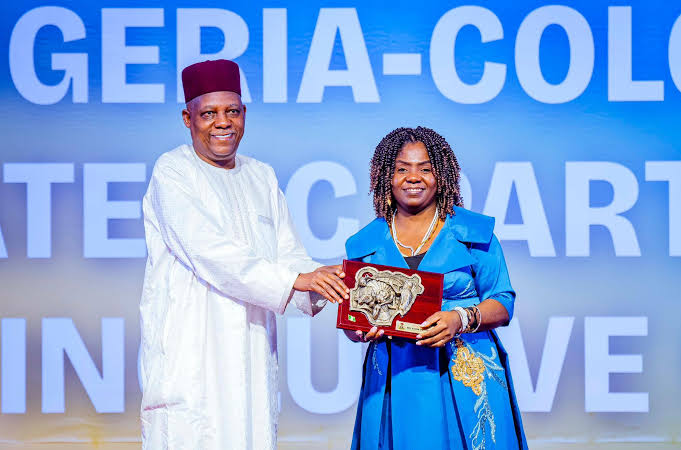
In a press conference held on the sidelines of the meeting between Nigeria’s Vice President Kashim Shettima and Colombia’s Vice President Francia Márquez, both sides reiterated the importance of the partnership for advancing diplomatic relations and sustainable development.
googletag.cmd.push(function() { googletag.display(‘div-gpt-ad-1718806029429-0’); });
The collaboration, Tuggar said, aligns with Nigeria’s ambitious eight-point agenda under President Bola Tinubu, which aims to reduce poverty and grow the middle class. Colombia, Latin America’s second-largest economy, is positioned as a key strategic partner in Nigeria’s efforts to strengthen ties with South America.
Tuggar highlighted the historical and cultural connections between the two nations, including their shared heritage rooted in the transatlantic slave trade. He noted, “Both Nigeria and Colombia are committed to pulling millions out of poverty and expanding the middle class during their current administrations,” reinforcing the symbolic importance of the ties in the year Africa focuses on reparations.
Trade relations, currently centred on agricultural commodities, such as sesame seeds and cocoa, are set for considerable expansion. Tuggar pointed to Colombia’s coffee production strength and Nigeria’s promising coffee-growing regions in Taraba, Kogi, and Ekiti states as new areas for cooperation.
“We are enhancing our Arabica and Robusta coffee yields, and Colombia’s expertise will be invaluable,” he said.
Beyond agriculture, economic collaboration will extend into energy and mining. He highlighted mutual interests, explaining that Colombia’s oil production and Nigeria’s refining capabilities offer synergistic potential. Both countries also have rich mineral resources, with Colombia known for emeralds and Nigeria advancing its Presidential Gold Mining Initiative, offering grounds for joint ventures.
On security, the officials committed to sharing lessons in counterinsurgency efforts. “Colombia’s success in ending insurgents like FARC provides important insights as Nigeria battles insurgencies, and we look forward to mutual learning in security strategies,” Tuggar remarked.
Deputy Minister Jassir outlined Colombia’s goal to diversify its economy beyond oil, coal, and gas, aligning with global sustainability demands. He emphasised the importance of shifting away from dependency on traditional power blocs, noting, “Nigeria’s leadership in West Africa makes it crucial in fostering stronger ties between Africa, the Middle East, and South Asia.”
In addressing multilateral challenges, Jassir criticised unilateral trade barriers and highlighted ongoing global crises, such as the conflict in Gaza, as undermining the principle of self-determination crucial for developing nations.
One focal point of practical cooperation is the bilateral air services agreement, currently under negotiation to enhance connectivity. “We are exploring direct flights linking Lagos to Colombia through Brazil, with Air Peace potentially acting as a bridge,” Tuggar explained. Improved air links will facilitate increased trade and cultural exchange.
Agriculture remains a priority sector, with Nigeria and Colombia working to diversify traded goods, backed by upcoming agreements on audiovisual and cultural cooperation. These are part of broader efforts to renew political consultations between the two countries, fostering systematic engagement.
On the global stage, Nigeria leads initiatives such as the United Nations Global Framework on Taxation, while Colombia champions responsible regulation of critical minerals.
Tuggar cautioned about unregulated mining activities in Nigeria’s northwest, which correlate with local conflicts, underscoring the necessity of sustainable governance in resource sectors to ensure peace and development.
Jassir reiterated Colombia’s inclusive approach to foreign relations, while Tuggar highlighted Nigeria’s strategic focus on the “four Ds”: Democracy, Demography, Development, and Diaspora, aiming for strategic autonomy.
Summing up, Minister Tuggar affirmed the partnership’s potential: “With strong political will, we can translate these opportunities in trade, culture, security, and international cooperation into tangible benefits for our peoples.”
The post Nigeria, Colombia strengthen ties with BASA, security cooperation, agric agreements appeared first on The Sun Nigeria.